
The Missing Link Between Information and Action
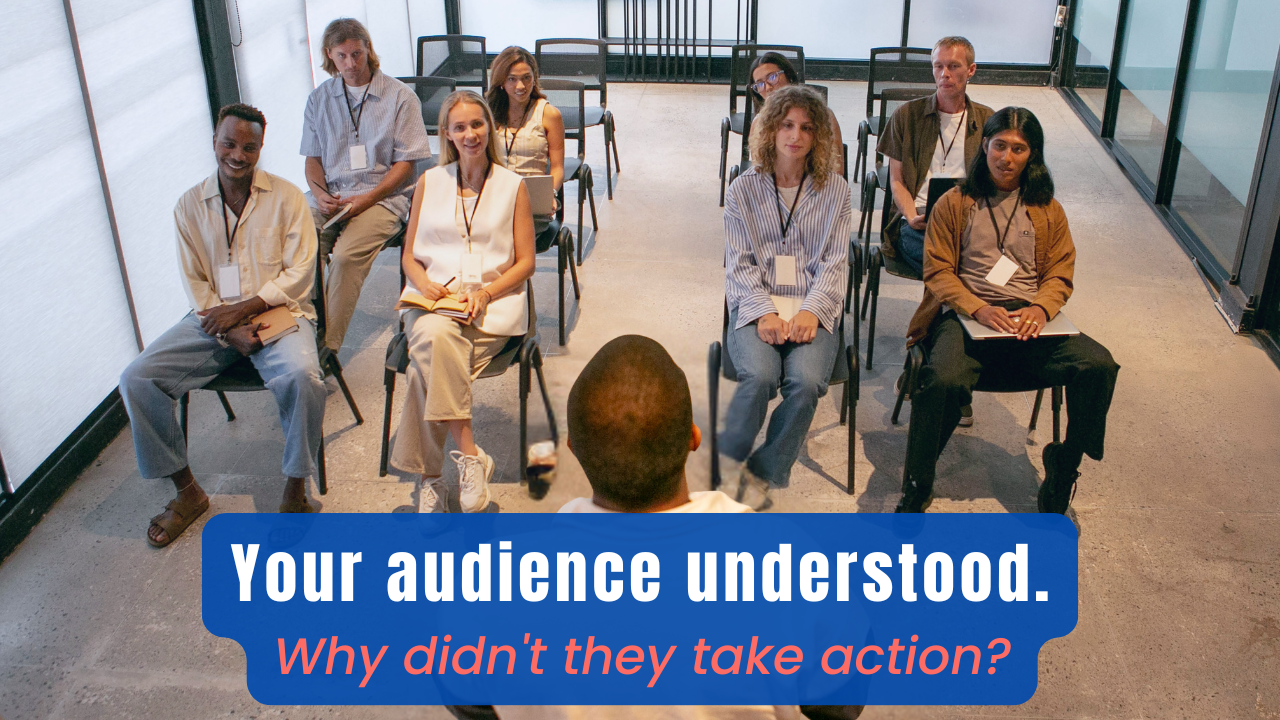
Why your audience may understand your message and still not act
The conversation had been going on for nearly an hour.
Adoption of the new initiative was slower than anyone expected.
The strategy was sound. The rollout had been thoughtfully planned. The communication had been reviewed, revised, and approved before it was released.
Yet the dashboard on the screen told a different story.
The numbers were flat. Engagement had stalled. People continued asking questions everyone thought had already been answered.
Finally, someone said what several others in the room seemed to be thinking.
“Do we need to send another email?”
It was a fair question.
When something is not gaining traction, the natural response is to communicate again. Send another email. Schedule another meeting. Add more details. Offer more training.
Perhaps people missed the message.
Perhaps they need a reminder.
Or perhaps another email would simply give them more of what did not work the first time.
That was the question running through my mind as the conversation continued.
What if the problem was never a lack of information but a lack of connection?
The Information Assumption
Most of us have been taught to think of communication as the transfer of information.
We have something people need to know, so we tell them.
Then we assume that once the information has been shared clearly enough, often enough, and through the right channels, people will take the next step.
It seems logical. Right?!
- If employees understand the new process, they will use it.
- If customers understand the value, they will buy.
- If members understand the benefits, they will register.
- If donors understand the need, they will give.
But information and action are not connected quite that neatly.
Researchers have used the term Information Deficit Model to describe the long-standing belief that people fail to support an idea or change their behavior because they do not know enough.
Give them the facts, the thinking goes, and the right response should follow. But there's a major piece missing...
[PRO TIP] People do not make decisions based on facts alone.
As humans with the ability to make choices, we tend to interpret facts through the lens of our needs, wants, desires, responsibilities, priorities, and experiences.
When our communication overlooks that reality, the connection begins to break down. Plainly said, people are trying to answer one question: "What's in it for me?" Not because they're selfish, but because they're trying to determine whether your message deserves their limited time and attention.
Think about the last time you were handed a restaurant menu. You were hungry, and your taste buds (from past experiences) naturally helped lead the way. Certain descriptions, ingredients, or even photos easily connected with memories of meals you'd previously enjoyed.
More often than not, making a decision came fairly quickly. Right?! But every once in a while, the menu is so extensive that deciding what to order feels like work.
Similarly, your audience needs what you're offering to connect to the problems they are trying to solve.
But when your business simply shares information without connecting the dots for your audience, something predictable happens.
- People postpone the decision.
- They continue doing what they've always done.
- Or they quietly tune out.
Why? Because your communication has not connected the information you’re sharing to what matters most to the people you are trying to reach.
Why Information Is Not Enough
Please don’t misunderstand. Information does matter because people cannot make informed decisions without it.
But having information and knowing what to do with it are two different things.
When your audience receives an announcement about a new initiative, product, process, or policy, they are not simply absorbing the words in front of them.
They are trying to place the message within the reality of everything else demanding their attention.
They may be wondering: Why does this matter? How does this help me do my job? What happens if I do nothing?
Those questions may never be spoken aloud, but they are subliminally shaping how the message is received.
When your communication doesn't connect and help them answer those questions, they are quick to tune out.
Why? Because today's audiences don't suffer from an information shortage. They suffer from an attention and connection shortage.
Every day they make countless decisions about what deserves their limited time and mental energy. If your communication doesn't quickly help them understand why it matters and connect to their world, they'll naturally move on to the next priority.
[PRO TIP] Information is necessary, but authentic connection is what moves people to action.
What Authentic Connection Means
To some, the concept of connection can sound soft, especially in business conversations where relationship building can feel removed from measurable outcomes.
In reality, authentic connection often produces some of the strongest and most enduring business outcomes because it creates trust, reduces uncertainty, and helps people move forward with confidence.
Unlike standard communication practices used by many today, authentic connection doesn't manufacture urgency, exaggerate a problem, or try to make a routine announcement sound life-changing.
Authentic connection meets people where they are by helping them understand how the information being shared relates to something they already care about, value, or need.
One of the best examples of this comes from the Master Marketer of the first century.
Long before anyone wrote books on leadership, marketing, or communication, He consistently met people where they were.
Throughout the stories about His life, we see Him:
- Using relatable stories that pointed to deeper truths.
- Speaking everyday language rooted in common experiences.
- Asking questions that invited people to think.
- Creating curiosity that drew people into the conversation.
- Listening before responding.
- Addressing the deeper issue instead of only the presenting problem.
Those communication principles are just as relevant in business today. Likewise, authentic connection begins when we take time to:
- Meet people where they are.
- Understand their priorities before pushing our agenda.
- Answer the questions they're already asking.
- Connect our message to the challenges they're trying to solve.
In other words, meeting people where they are means connecting your message to something that genuinely matters in their world. That could be helping them save time, reduce risk, accomplish an important goal, make a confident decision, avoid unnecessary frustration, or simply do their job well.
Your audience—whether customers, employees, members, donors, or investors—rarely acts simply because you gave them information.
[PRO TIP] People act when you've connected that information to something that matters in their world.
That connection doesn't guarantee immediate action. Timing, budgets, competing priorities, and countless other factors still matter. Connection creates the conditions for action when the time is right.
But when the connection is missing, even the right message will probably fall flat because your audience has not been given a reason to make it a priority.
Before You Communicate, Ask These Five Questions
By now, you may be wondering, How do I actually do this?
Authentic connection isn't something we manufacture; it's something we discover.
The better we understand the audience we're trying to reach, the easier it becomes to communicate in ways that are relevant, helpful, and connect.
To do this well requires an investment on your part to listen, ask better questions, and be genuinely curious BEFORE you create any communication.
Here are five questions you'll want to ask.
1. What outcome do we hope to achieve?
Before you communicate, define your desired outcome. (Or as you've heard me say in other forums, start with the end in mind.)
You'll do this by pre-determining your end goal, the decision you hope your audience will make and the action you'll invite them to take.
If you aren't clear about where you're trying to go, it becomes difficult to determine what you need to communicate.
2. Where is your audience starting?
As it pertains to your project, what does your audience already know? Are there assumptions they might possess? Are there common experiences that might shape how they receive your message?
The better you understand where your audience is starting, the better equipped you'll be to meet them where they are.
3. What do they need to understand... and do?
Notice the question isn't, "What do you need to tell them?" Why? Because that's an information mindset.
Instead, ask yourself: What do they need to understand in order to confidently take the next step? And...What do they need to do as a result?
Remember: the goal is to communicate in a way that authentically connects to what matters most in their world.
4. What matters most to them right now?
This is where authentic connection begins to take shape.
Don't expect your audience to connect your message to their world. Do that work for them.
Help them see how what you're communicating connects to the priorities, challenges, opportunities, or decisions they're already navigating.
When you make people search for the relevance, they will check out faster than you can say 'cheese.'
5. What might hold them back?
Sometimes the obstacle is uncertainty, competing priorities, an unclear process, a lack of confidence, or simply not seeing enough value to make the next step a priority.
The better you understand what might create hesitation, the better equipped you'll be to address it.
Notice what these five questions have in common: They begin with your audience, not your message. And that's the shift.
When you stop asking, "What do you want to share?" and start asking, "What does our audience need?" your communication changes.
And that's where authentic connection begins.
So the next time an initiative stalls, registrations lag, engagement drops, or customers fail to respond, resist the urge to immediately ask: "Do we need to send another email?"
Perhaps a better question is: "Have we connected what we're communicating to what matters most to the people we're trying to reach?"
Organizations rarely struggle because they have too little information to share.
More often, they struggle because they haven't connected that information to what matters most to the people they're trying to reach.
[PRO TIP] Information is necessary. But authentic connection is what moves people to action.